Dr Zibdeh Signature
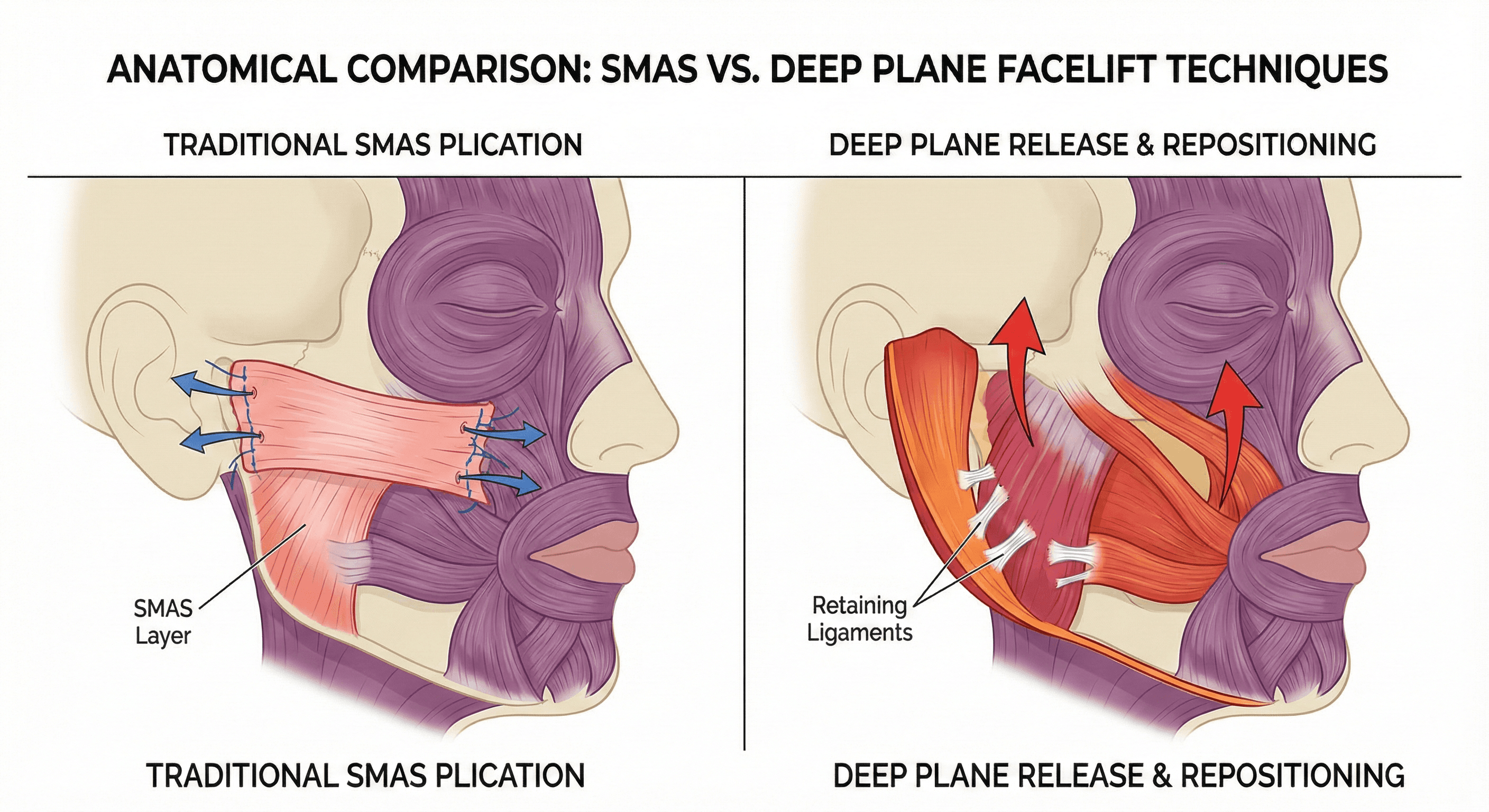
The Deep Plane Facelift represents a distinct surgical approach compared to the traditional SMAS (Superficial Musculo-Aponeurotic System) plication or imbrication techniques. To understand the difference, one must look at the facial anatomy. The face is arranged in layers: skin, subcutaneous fat, the SMAS layer (muscle and fascia), and the deeper retaining ligaments that anchor soft tissue to the bone. In a traditional facelift, the surgeon lifts the skin and tightens the SMAS layer separately, often by folding it over itself (plication). While this tightens the jawline, it relies on the skin to hold much of the tension and often fails to address the midface adequately because the retaining ligaments remain tethered.
In contrast, the Deep Plane technique involves dissecting underneath the SMAS layer. The critical step in this procedure is the surgical release of the zygomatic and masseteric cutaneous ligaments. These ligaments act as strong tethers that hold the cheek fat and midface tissues in a lower, aged position. By releasing these ligaments, the surgeon can mobilize the entire composite flap—consisting of skin, muscle, and fat—as one unit. This allows for a vertical lifting vector, moving the fallen malar fat pads back over the cheekbones, rather than a horizontal pull that can widen the mouth or flatten the face.
Because the release occurs at a deeper level, the skin itself is not separated from the underlying blood supply and is not used to pull or lift the face. The tension is placed entirely on the durable fascia of the deep plane. This lack of tension on the skin closure is medically significant for two reasons: it minimizes the risk of hypertrophic scarring or "pixie ear" deformity, and it preserves the capillary network to the skin, reducing the risk of necrosis (tissue death) in smokers or patients with compromised circulation. The result is a structural restoration of the facial architecture that addresses the nasolabial folds and tear troughs, areas that superficial techniques typically cannot correct.